| |
 |
|
JK-HairCoat — Five Application Methods |
|
 |
 |
 |
|
|
| |
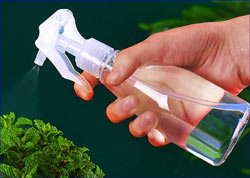
Method C is a non-immersion, low-contact method used when soaking or dipping is impractical.
Structural Limitations
-
Significant solution loss into the air
-
Lower percentage of solution actually reaches the hair
-
Risk of spraying onto face, neck, or surroundings
Why Higher Concentration Is Required
Because delivery efficiency is low, the solution concentration must be increased to compensate for loss.
Typical Mixing Range
|
 |
 |
|
 |
STEP 1 — Prepare the Solution |
| |
Prepare 50 ml of warm water (40℃) 500 ml in a container (long enough for hair length) |
| |
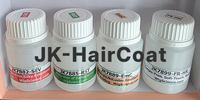
put a JK-HairCoat, 5 ml into the water (500 ml) in the ratio of 5:500 (1:100) - a 1% solution, and stir the mixture with a stirring stick to be mixed evenly without build-ups (pileup) for 10 seconds as fast as possible,
and pout the solution into a sprayer, |
 |
STEP 2 — Apply JK-HairCoat to the Hair |
| |
spray JK-HairCoat solution to human hairpiece, or a wig placed on a metal or plastic tray, or a styling(rubber) head |
 |
STEP 3 — SPIN-DRYING (REMOVAL OF EXCESS SOLUTION) |
|
have the hair dried in air (natural drying), in a heated room, in an oven (drying machine). |
 |
STEP 4 — DRYING |
|
Detailed Drying Methods  |
 |
|
|
| |
 Please have the dried hair
cooled down for hours.
 Please do not touch (pull, stretch, rub, hackle) the hair when the hair is (feels) warm after drying using an oven. |
| |
|
X |
1% solution:
When you use a HAIR SPRAYER for treatment of the HairCoat, please make 1% solution
( 5 ml of a HairCoat : 500 ml of Water).
We call this mixing ratio "1% solution".
You may try 1.5% solution (7.5 ml of JK7882-SEV + 500 ml of water, or 2% solution.
This mixing ratio
is MUCH MORE than 0.3% solution
mentioned in the Use Instructions for Treatent Method A.
(By spraying, all the ions of our hairCoat can not reach even
and enough to every part of
each single strand hair, and a lot of (the ion of) Haircoat
is to be wasted in the air.Therefore, a higher percentage of HairCoat must be mixed with water.) |
Y |
|
Z |
0.02% solution:
Video Reference
 Video  : Demonstration using a 100-liter container used in:
-
Submerging 10 kg of hairpieces in a solution made with --- 0.2% solution (60/30,000)
60 ml of JK7882-SEV + 30 liters of water
-
Or submerging 20 kg of hairpieces using --- 0.2 % solution or 0.125% solution (100/50,000 or 100/80,000)
50–80 liters of water + 100 ml of JK7882-SEV
Of course, the mixing ratio has functional relation with the effect you or your customer like, hair propertiese, hair's conditions, etc.
|
|
| |
| |
| The mixing ratio (always or each time) can be different according to hair's conditions (qualities, properties),
what products you will make with the hair in case of raw material bulk hair, softness/silkiness amount(degree) you or your customer request(want), the amount (quantity) of hair to be treated at a time, the size of a container for putting and mixing a HairCoat and water will be mixed, treatment methods (soaking, dipping, rubbing, spraying). |
| One Unified Conclusion |
 |
All four methods apply the same chemistry. |
|
The differences lie only in delivery efficiency, physical assistance, and working conditions. |
|
Understanding Method B provides the key to understanding why Methods A, C, and D behave as they |
|
|
 |
Decades of experience. Proven technology. Real-world application.
 Since 1984, we have manufactured and exported hand-made toupees, women’s wigs — both hand-made and machine-made, using human hair and synthetic fibers — as well as hairpieces and other hair goods, including lace closures, lace toppers, synthetic braids, and human hair wefts.
 In 1992, as industry conditions evolved and global production structures shifted, we entered our second business phase and expanded beyond finished hair products into developing the machines, process systems, and chemical products used to produce wigs, hairpieces, and other hair goods.
 In 2000, we further expanded into the production and export of base materials, including nets, meshes, and lace fabrics, as well as synthetic hair fibers used in wig and hairpiece manufacturing.
 Alongside manufacturing, we have provided hands-on training worldwide — from large-scale factory programs involving thousands of workers to one-to-one training for professionals, company trainees, and complete beginners from more than 30 countries.
Through continuous collaboration with global buyers and partners, real market feedback is directly applied to our development process. This allows us to refine machines, improve chemical formulations, and create practical, scalable solutions that work in real production environments.
 This complete cycle of manufacturing, technology development, education, and market feedback is what we call Integrated Wig Science.
|
 |
| |
|
|
 |
 |
 |
 |
| (2)850+ |
 |
 |
|
|
| Copyright© JohnKorea Co® · All Rights Reserved – Seoul, Korea |
|
|
|
|
|
| |



