
 |
Customer Feedback of JK-HairCoat Users |
 |
|
||
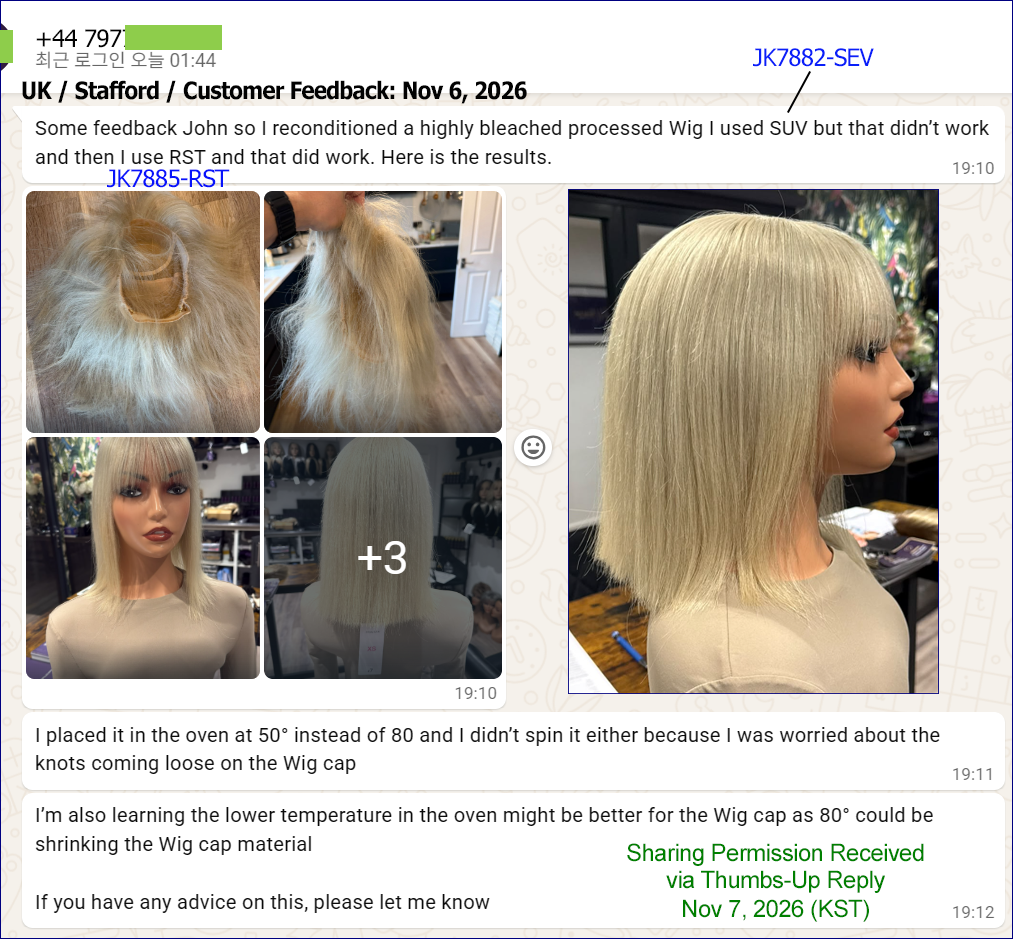
 Feedback from UK / Stafford / Product : JK-HairCoat JK7885-RST and JK7882-SEV
Some feedback John so I reconditioned a highly bleached processed Wig I used SEV but that didn’t work and then I use RST and that did work. Here is the results.
 Feedback from USA / San Francisco / Product : JKHairCoat JK7882-SEV
The coating doesn’t affect the knots in the lace as long as the hair is ventilated with a single strand.
The knots are more likely to loosen when the hair is ventilated with 2–3 strands or half-single knots, with or without your coating.
It has more to do with how the hair is ventilated and how tightly the knots are tied.
If the ventilation is not tight enough, even regular washing or shampooing can cause the knots to loosen.
I prefer the dipping method rather than spraying when applying the coating to individual hairpieces. Spraying doesn’t seem to distribute the coating evenly throughout the hair.
I use a 1.5% ratio of JK-HairCoat mixed with warm to hot water, but not boiling. I also use a handheld kitchen blender to mix the solution evenly.I start dipping from the tips of the hair, gradually immersing the sides and back, then the top and front lace sections.
If the piece has a poly base around the edges, I try to dip the hair as close to the base as possible without getting the coating on the poly. If any solution gets on the base, I immediately wipe it off or use alcohol to clean it.
For the top section, if it’s lace or net, I don’t worry too much about immersing the net itself because I don’t use tape or bonding there.
However, the front lace is more delicate, especially if tape or glue is used. I recommend dipping only the hair carefully rather than immersing the entire front lace.
The reason I’m cautious is that I don’t know whether the coating could affect the longevity of the bonding method I use.
If someone uses tape on the lace, I would recommend avoiding getting the coating on that area because the tape may not stick properly. Also, depending on the type of lace, removing the coating afterward may not be easy.

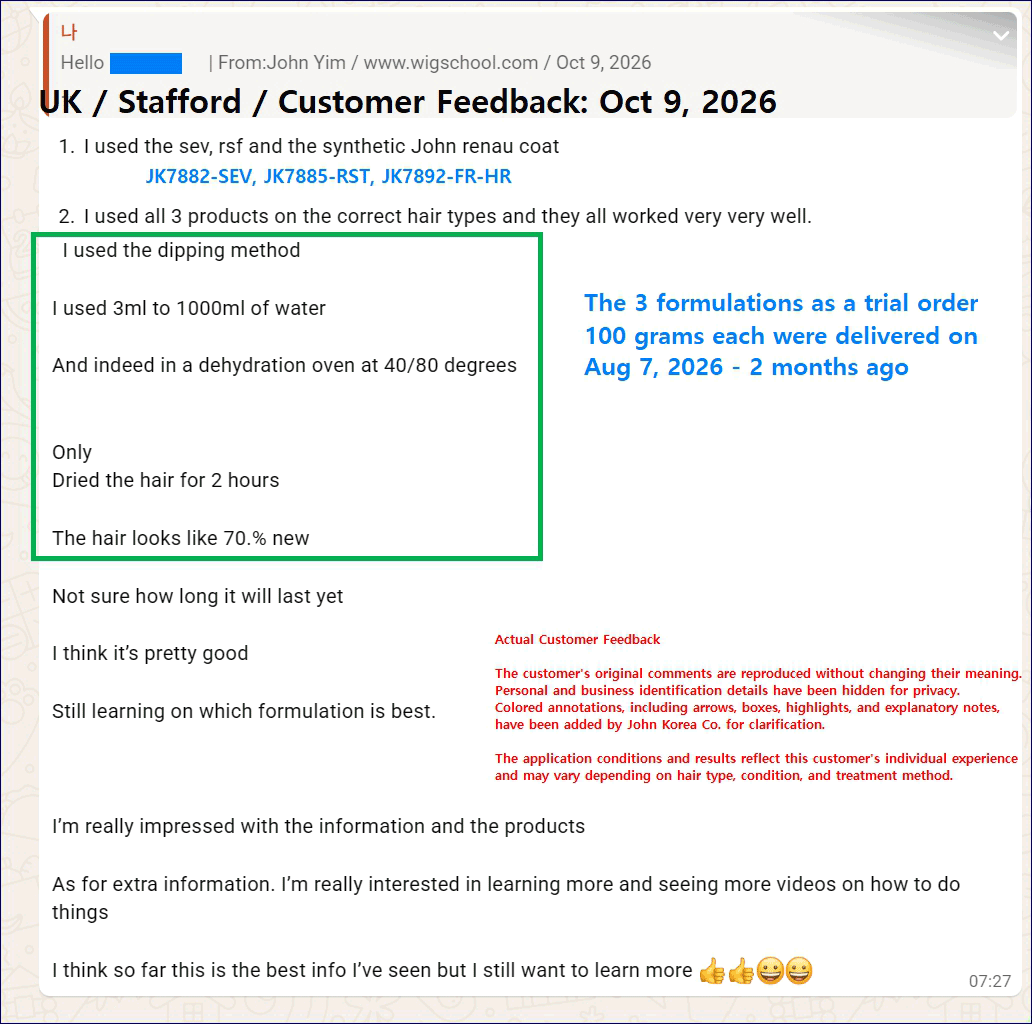
 Feedback from UK / Stafford / Product : JKHairCoat JK7882-SEV, JK7885-RST, JK7882=FR-HR (Heat Resistant Fiber, high temperature synthetic fiber)

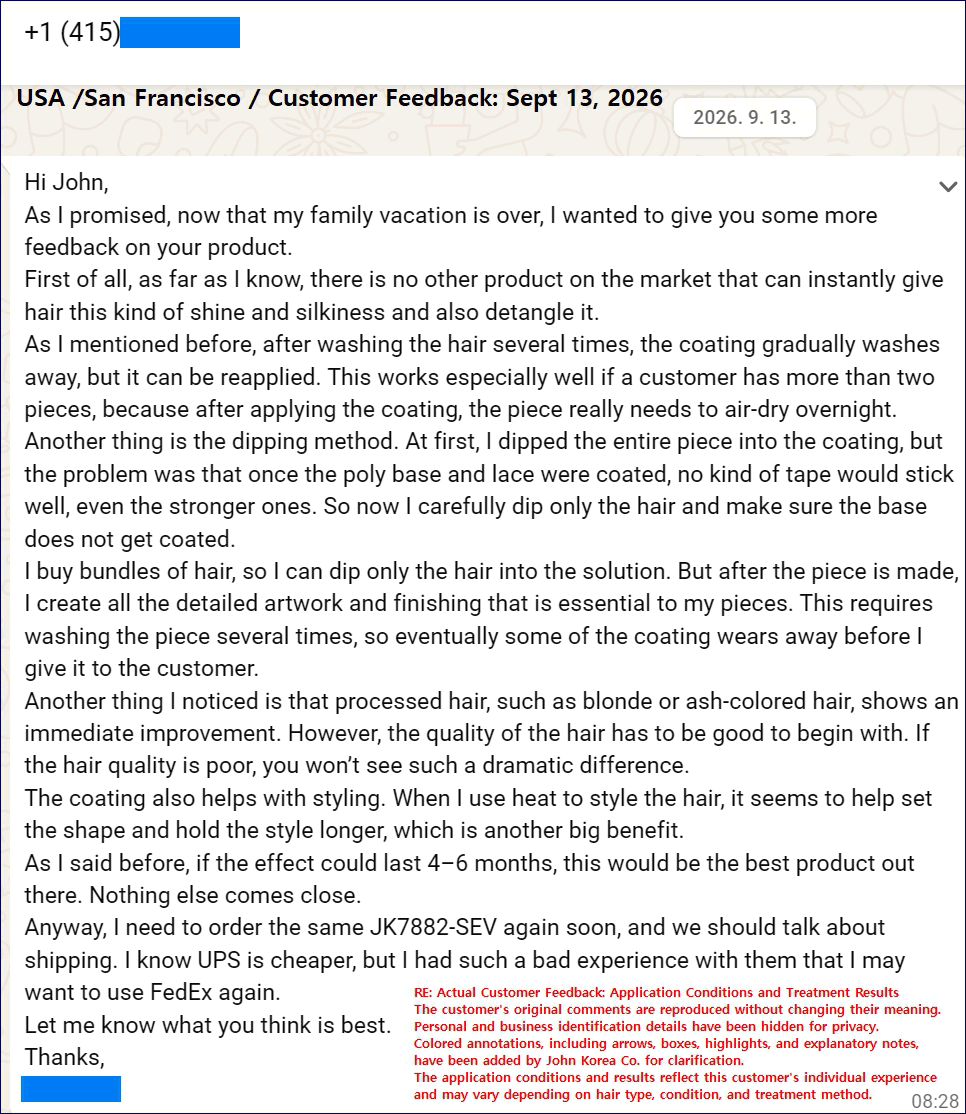
 Customer Review 2026-07-18 (UK)
UK customer – JK7882-SEV (200 g) shipped on May 28, 2026 by FedEx (EP#3)
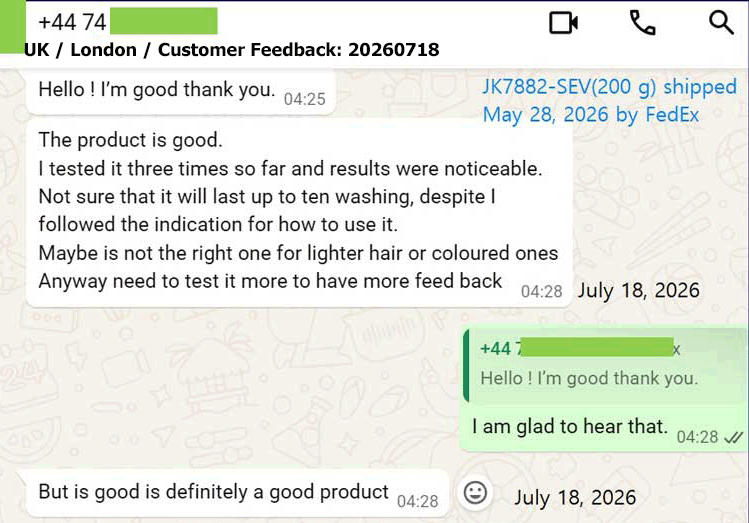
Technical Comments:
Thank you very much for your honest feedback.
I am very pleased to hear that you noticed the results after testing it three times, and I especially appreciate your comment that it is definitely a good product.
Regarding your two observations:
The durability depends greatly on the condition of the hair. Untreated or less-damaged hair usually maintains the effect much longer than heavily bleached or damaged hair.
One point I would like to clarify is that the ionic bonding itself does not normally become weak or break down during washing.
Rather, repeated combing, brushing, blow-drying, friction, and everyday wear gradually remove tiny portions of the hair cuticle itself. Since JK-HairCoat is ionically bonded to the cuticle surface, when the cuticle is physically worn away, the bonded coating is removed together with it. This may give the impression that JK-HairCoat has lost its effectiveness, even though the ionic bonding itself remains stable.
This phenomenon is more noticeable with very light blonde or heavily bleached hair.
The longer the bleaching process, the more the cuticle becomes weakened and porous, making the hair surface easier to wear away during daily use.
For this reason, we have developed several JK-HairCoat formulations for different hair conditions and purposes, rather than relying on a single formulation for every type of hair.
Please continue your tests whenever you have time. Any comments—positive or negative—are very valuable to me for further improving the product.
Thank you again for taking the time to test it and share your experience.
Best regards,
John / JULY 18, 2026 5:10 AM (Seoul, Korea) #F7F7F7
Related Technical Notes:
For general technical information, please visit: https://www.wigschool.com/technical-notes.htmPlease note:
Some additional technical notes, recommendations, or reference links shared during individual technical discussions are not included on this page.
Many of them are specific to particular formulations, hair conditions, application methods, or stages of product evaluation, and are shared when they are most helpful to each customer's particular application.
 Customer Review 2025-04-01 (USA)
April 1, 2025
US customer – JK7882-SEV (200 g) shipped on March 28, 2025 by UPS (EP#3)
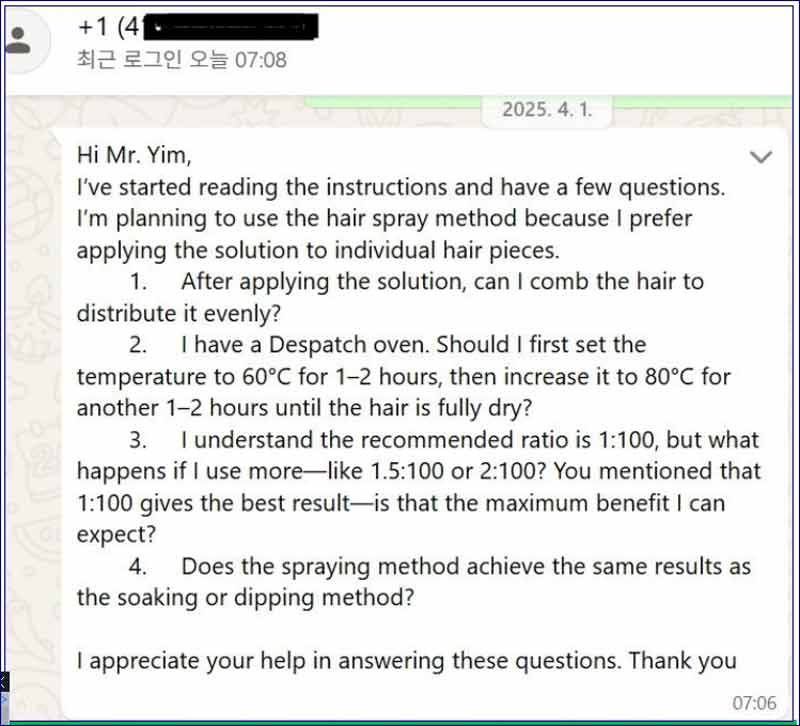
Technical Comments:
RE { 1.After applying the solution, can I comb the hair to distribute it evenly? }
<> Yes. You need combing to distribute it evenly, but more important reasons to avoid build uos ( pileup) between hair strands. If possible, please spin-dry it.
RE { 2. I have a Despatch oven. Should I first set the temperature to 60°C for 1–2 hours, then increase it to 80°C for another 1–2 hours until the hair is fully dry? }
After shipping, I sent you the instructions for using JK-HairCoat, including the recommended drying method.
① Temperature: 75–80°C
② Before placing the hair in the oven, spin-dry it until approximately 80% of the water has been removed.
The purpose of spin-drying is not to dry the hair completely. A good guideline is to remove enough water so that water is no longer dripping from the hair, while the hair still retains some moisture.
Important: Do not spin-dry the hair until it is almost completely dry.
If the hair becomes almost completely dry inside the spin dryer, the hair fibers are repeatedly pressed, rubbed, and compressed against each other while rotating at high speed. This unnecessary mechanical friction may cause physical damage, such as increased tangling, cuticle wear, surface abrasion, or deformation of the hair bundle.
The remaining moisture acts as a natural lubricant and cushion between hair fibers during spin-drying, helping to reduce friction and protect the hair.
The spin dryer should therefore be used mainly for water removal, not for drying the hair itself. The final drying should be completed gently in the oven or by natural air drying.
③ Drying Time:
Approximately 2 hours or longer, until the hair is completely dry.
Alternatively, you may set the oven to 60°C for the first 1–2 hours, then increase the temperature to 80°C for another 2 hours or longer until the hair is completely dry.
When the drying cycle begins, the oven temperature naturally rises from room temperature (for example, 25°C → 40°C → 50°C → 60°C). After resetting it to 80°C, it will gradually increase to about 70–80°C.
After drying, allow the hair to cool naturally in the oven or at room temperature for several hours or overnight before packing, combing, or evaluating the results.
The required drying time depends on factors such as the amount of hair, the amount of remaining moisture after spin-drying, and the oven's airflow efficiency.
You may compare both drying methods to determine which drying cycle works best for your particular hair and production conditions.
CAUTION – Human Hair
Human hair that has been heavily bleached (especially to very light blonde shades), repeatedly dyed, frequently flat-ironed or otherwise heat-styled, or severely weakened by friction or previous chemical treatments may be further damaged by excessive heat.
For such hair, natural air drying is the safest method. If an oven must be used, we recommend using the lowest practical temperature (preferably below 40°C), although a longer drying time will be required.
Excessive heat does not damage JK-HairCoat itself. However, it can further weaken or damage already fragile human hair.
CAUTION – Synthetic Hair
Most synthetic fibers have much lower heat resistance than human hair. Unless the fiber is specifically manufactured as High Heat-Resistant Fiber, oven drying is not recommended.
Natural air drying is recommended whenever possible. If an oven must be used, keep the temperature below 30–40°C, or never exceed 60°C, depending on the fiber manufacturer's heat-resistance specification.
Because different types, origins, processing histories, and conditions of hair respond differently to heat, the drying temperature and drying time should be adjusted accordingly while ensuring that the hair is completely dry.
Always determine the most suitable drying conditions through your own preliminary trials before starting commercial production.
RE { 3.. I understand the recommended ratio is 1:100, but what happens if I use more—like 1.5:100 or 2:100? You mentioned that 1:100 gives the best result—is that the maximum benefit I can expect? }
<> I would rather not use the word "best."
Please try the different mixing ratios you mentioned and compare the results.
The term "human hair" covers countless combinations of properties, such as hair origin, thickness, cuticle condition, porosity, previous chemical treatments, and many other characteristics.
From my experience and from feedback from other users, an excessively concentrated solution (for example, over about 1% or 2%) may cause unnecessary build-up, making the hair feel oily, sticky, heavy, or wet-looking.
More JK-HairCoat does not necessarily produce better results. The objective is to use the optimum amount for each type and condition of hair.
RE {4. Does the spraying method achieve the same results as the soaking or dipping method? }
<>Generally, no. However, under certain conditions, the answer can also be "Yes," depending on how you apply JK-HairCoat.
If you spray with one hand while separating and lifting the hair with the fingers of your other hand, every hair strand can be evenly and thoroughly wetted.
The objective is not whether you spray or dip the hair. The real objective is to apply the correct amount of JK-HairCoat as evenly as possible to every hair strand.
Related Technical Notes:
For general technical information re "SPIN-DRYING", please visit: https://wigschool.com/==heat.htmPlease note:
Some additional technical notes, recommendations, or reference links shared during individual technical discussions are not included on this page.
Many of them are specific to particular formulations, hair conditions, application methods, or stages of product evaluation, and are shared when they are most helpful to each customer's particular application.


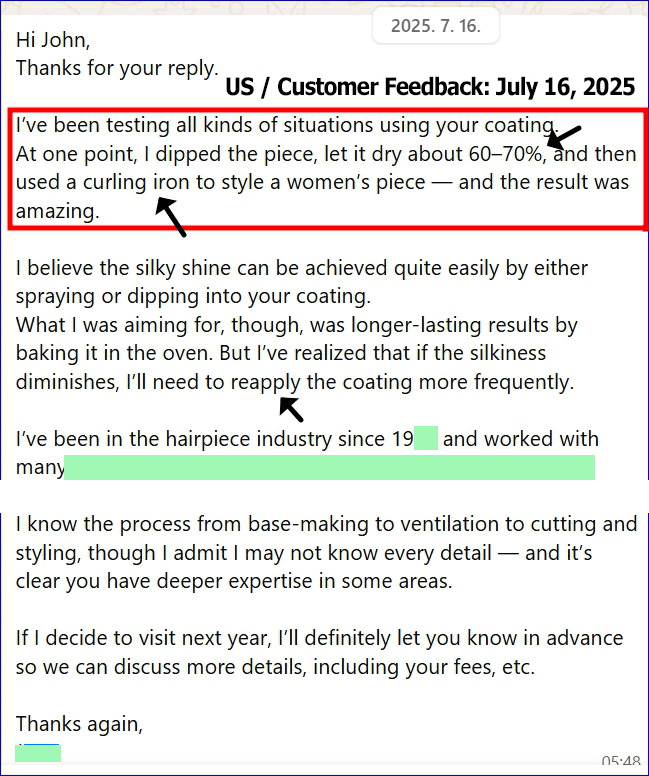

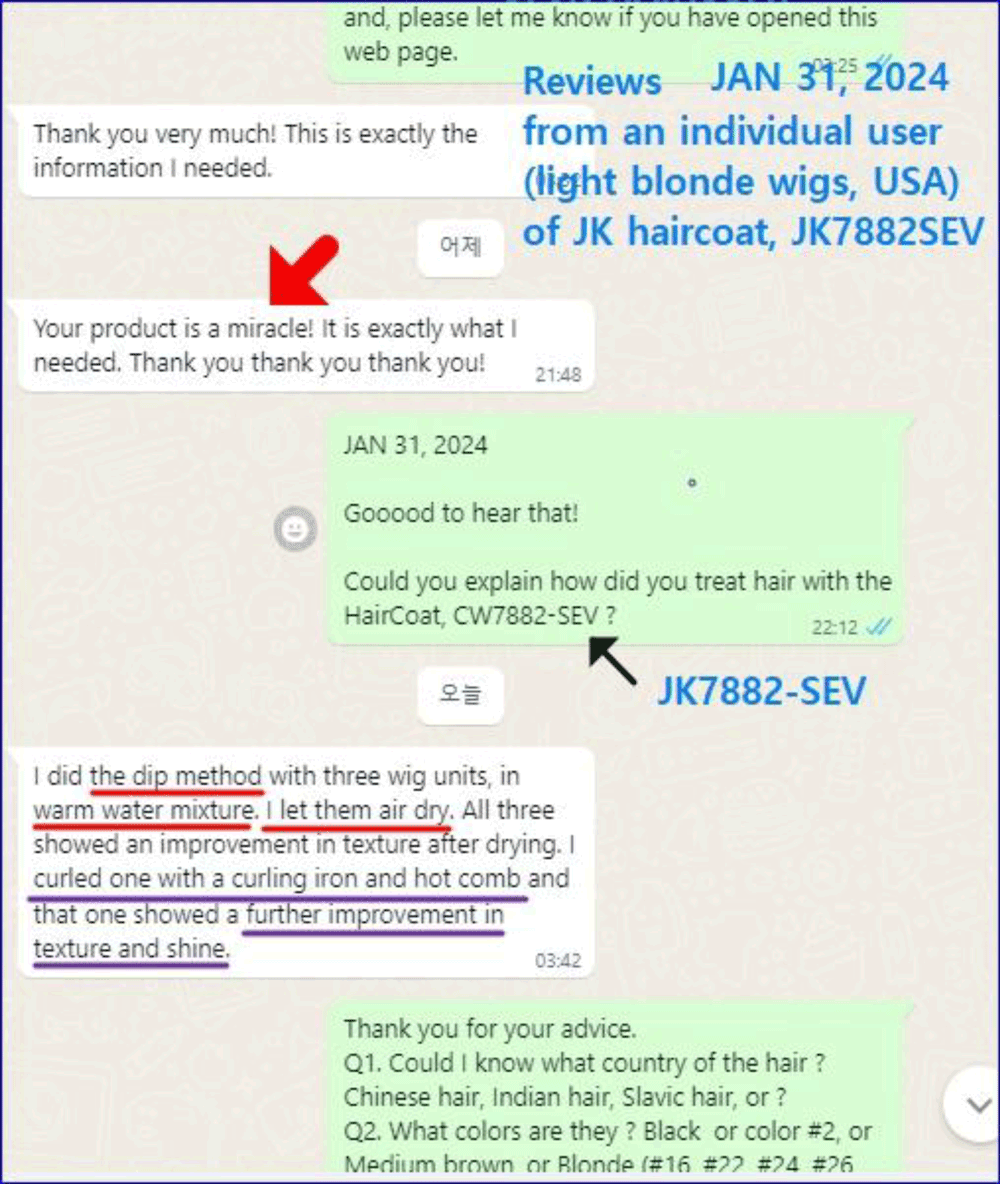


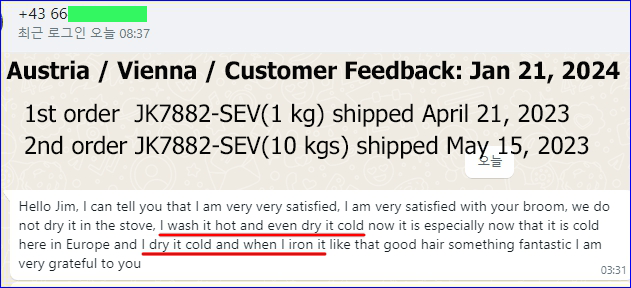


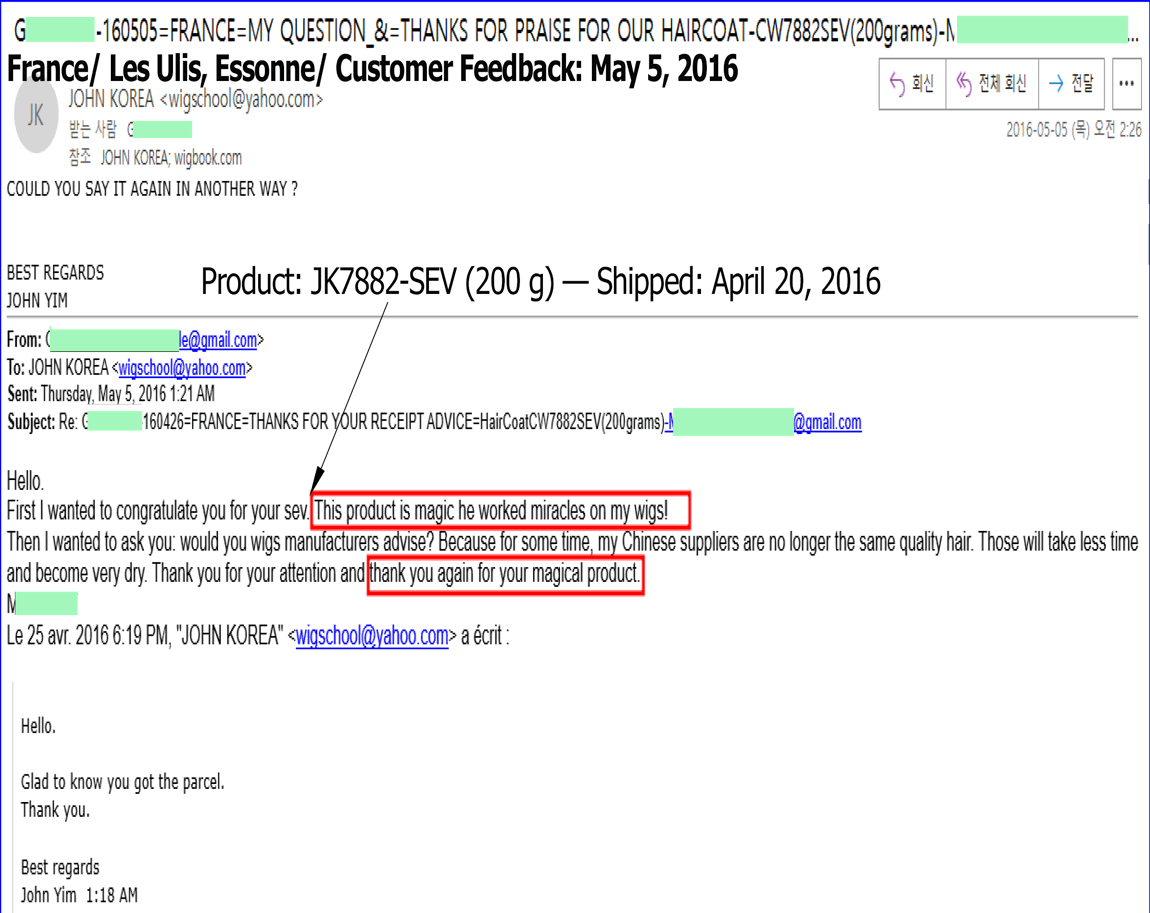
 USA — Customer Review on HairBoutique Forum (April 2, 2009)
"I love this products."
"I really love this product, it is one of a kind, nothing compares to it. The silky smooth effect + shine do go away after about 14 shampoos I would say but, the hair remains globally much nicer than it would be if the HairCoat treatment had not been performed. So in a way, it is a permanent improvement, only the most noticeable effects will fade away.
Basically, this install looks and feels younger than it should at this point, the hair that is more than 2 months old feels — not like 2 months old at all, it feels much much better. :Y:
I noticed that it improves the “waterproofing” of the hair too. In humid weather, I usually have my Bohyme going puffy and crazy on me, and this hair behaves a ton better now in case of rain. So it’s another big plus, and a permanent one."
USA — Customer Review on HairBoutique Forum (April 2, 2009)
An independent customer shared a detailed review of JK-HairCoat on the HairBoutique Forum in 2009.
The review covers practical application methods, treatment results, repeated shampooing, durability, and the effects of using different concentrations.
Read the original customer review on HairBoutique Forum 
 Note: This external website may occasionally be unavailable due to server issues.
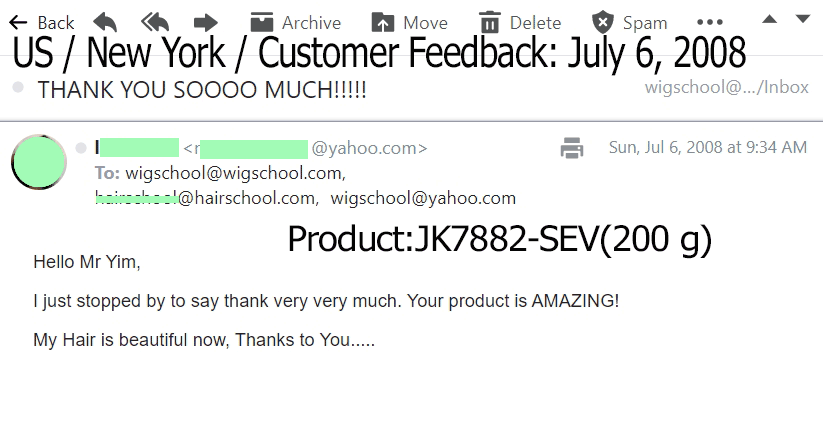
Technical Comments:
Water quality may influence the efficiency of ionic bonding and the overall performance of the treatment.Related Technical Notes:
For general technical information, please visit: https://www.wigschool.com/technical-notes.htmPlease note:
Some additional technical notes, recommendations, or reference links shared during individual technical discussions are not included on this page.
Many of them are specific to particular formulations, hair conditions, application methods, or stages of product evaluation, and are shared when they are most helpful to each customer's particular application.
|
|||||||||||||
|
|||||||||||||
 |
 |
 |
 |
 |
|||||||||
| (2)850+ |  |
 |
 |
||||||||||
| Copyright© JohnKorea Co® · All Rights Reserved – Seoul, Korea Cell & WhatsApp (Mr. John Yim) : +82-10-8686-1313 |
|||||||||||||



