 |
JK-HairCoat™ — Questions & Answers (FAQ) |
||
 |
JOHN KOREA CO. | WIG SCHOOL™ Consolidated and Revised — November 2026 |

Technical Note
The below information is based on JOHN KOREA CO.'s practical manufacturing experience, recommended application methods, customers' questions, and customer feedback.
Results may vary depending on the hair quality, previous chemical processing, application conditions, and drying methods.

Approximately 66 kg of human hair.
Using our standard dipping method:
-
3 g of JK-HairCoat can treat approximately 1 kg of hair.
-
200 g of JK-HairCoat can treat approximately 66 kg of hair.
-
1 kg of JK-HairCoat can treat approximately 333 kg of hair.

For example, with just 3 g of JK-HairCoat, you can treat:
-
5 wigs, each containing approximately 200 g of hair.
-
10 hair extensions or wefts, each weighing approximately 100 g.
Simply mix 3 g of JK-HairCoat with 1 liter of water (approximately 40°C) and treat the hair using the dipping method.
Note: These are general estimates. Actual consumption may vary depending on hair type, condition, and application method.
Hi John
I’ve done my first test and seems to be pretty good,
I’m just waiting for my oven to be delivered,
Just a few questions
1. Is it best to use a clarifying shampoo?
2. Does the oven make it a lot better ?
3. if I use more solution do I get a better effect ?
Just wanted to say thankyou as I can see one I get a little better this is really going to work well.

1. Product Selection and Effects
Q: Which JK-HairCoat formulation would you recommend for straight human hair?
A: The selection of a JK-HairCoat formulation is not determined solely by whether the hair is straight, wavy, or curly.
More important factors include the hair quality, previous chemical processing, degree of damage, present surface condition, and the finishing effect you want to achieve.
JK7882-SEV is our standard formulation and is generally a good starting choice for human hair.
Q: Which formulation would you recommend for curly or wavy human hair?
A: JK7889-EmC is one formulation to consider for curly or wavy hair.
However, the hair's texture alone does not determine which formulation will produce the best results.
The hair quality, chemical processing history, degree of damage, and desired softness, smoothness, and shine should also be considered.
The application method is particularly important when treating curly, wavy, afro, or kinky hair.
Q: Which formulation provides the strongest and most durable anti-tangling effect?
A: Based on our practical experience, JK7882-SEV is generally our first recommendation for a strong and durable anti-tangling treatment.
However, actual results depend on the hair quality, previous chemical processing, application method, and drying conditions.
Q: Which formulation best preserves the natural curl or wave pattern?
A: Preserving the original curl or wave pattern depends not only on the formulation but also on the application and drying methods.
For curly or wavy hair, avoid unnecessary combing, pulling, stretching, or straightening during treatment.
JK7889-EmC may be considered, but the best results should be determined through small-scale testing.
Q: Can different JK-HairCoat formulations be combined?
A: Yes. Different formulations may be used to obtain customized finishing effects.
Our formulations share many of their basic functions, while each has certain differences in its finishing characteristics.
However, I recommend testing each formulation separately on the same type of hair before experimenting with combinations.
The selection and proportions should be based on the hair condition and desired results rather than simply on whether the hair is straight, wavy, or curly.
For application methods involving more than one formulation, please contact us by email or/and WhatsApp.
Q: Can JK-HairCoat help prevent tangling in human hair with intact cuticles?
A: Yes. JK-HairCoat is designed to form an extremely thin protective layer around individual hair strands, helping smooth uneven surfaces and reduce friction between strands.
This can help prevent or reduce tangling and improve softness, smoothness, shine, and combability.
However, JK-HairCoat is not a cuticle-removal chemical and cannot completely correct reversed cuticles, severely damaged hair, or improperly processed hair.
Please refer to our product list:
https://wigschool.com/list-1.htm
2. Mixing Ratios, Quantity, and Application
Q: What is the standard mixing ratio for the dipping method?
A: Our standard recommended starting concentration is approximately 0.3%, or:
-
JK-HairCoat: 3 g (approximately 3 mL)
-
Water: 1,000 mL (1 liter)
We generally recommend using water at approximately 40°C (104°F).
Stir the mixture thoroughly for approximately 20–30 seconds before treatment.
The concentration may be adjusted depending on the hair condition and desired results.
Q: Can I make the dipping solution more concentrated?
A: Yes, but I recommend starting with 3:1000 rather than automatically increasing the concentration.
If necessary, you may compare 3:1000 and 5:1000 on small samples of the same hair.
A higher concentration does not necessarily produce better results.
The important factors are the proper concentration, even application, removal of excess solution, and appropriate drying.
Q: If I use more solution, will I get a better effect?
A: Not necessarily.
Once the hair has been sufficiently and evenly treated, using additional solution may simply waste the product.
JK-HairCoat is an emulsion-based formulation. Excessive application or inadequate removal and drying may leave residues that cause the hair to feel oily, heavy, or sticky.
The objective is to apply JK-HairCoat evenly to the individual hair strands, not to use as much solution as possible.
Q: How long will a 200 g bottle of JK-HairCoat last? How many wigs can it treat?
A: Only a very small quantity of JK-HairCoat is required.
As a general guideline, approximately 3–5 g of JK-HairCoat can be used to prepare 1 liter of dipping solution.
This quantity may be sufficient to treat approximately 1 kg of hair, equivalent to five wigs containing 200 g of hair each.
For example, using 5 g of JK-HairCoat per treatment of five wigs:
200 g ÷ 5 g × 5 wigs = approximately 200 wigs.
At a concentration of 3 g per treatment, the theoretical number would be higher.
Actual consumption depends on the quantity of hair, application method, concentration, and handling losses.
You do not need to prepare 1 liter of solution for every wig. A smaller quantity may be prepared while maintaining the same mixing ratio, provided there is enough solution for proper treatment.
Q: Can I treat several wigs together in the same solution?
A: Yes, provided there is sufficient room and solution to treat the hair evenly.
Gently immerse, turn, and press the hair so the solution reaches the individual strands.
Avoid overcrowding the container.
For curly, wavy, or delicate hair, use an appropriate method that does not unnecessarily disturb its original texture.
Q: Can JK-HairCoat be sprayed onto a wig instead of using the dipping method?
A: Yes. Spraying is one of our recommended application methods.
For spraying, the standard starting concentration is approximately 1.0%, or 10 g of JK-HairCoat per 1,000 mL of water.
This is higher than the normal dipping concentration because some of the spray is inevitably lost into the air or does not reach the hair.
However, spraying may not provide uniform coverage throughout thick, dense, or highly curly hair.
For these types of hair, dipping or another suitable application method may be more effective.
Spraying does not necessarily replace the complete dipping and drying treatment.
Q: Does the spray solution have to be freshly prepared and hot? Can I store it for several days?
A: We recommend preparing the solution shortly before use for the most consistent results.
The water does not have to remain hot during spraying.
However, once JK-HairCoat is diluted with water, contamination from dust, microorganisms, or other substances may affect the solution over time.
For this reason, we recommend using a freshly prepared solution rather than storing a diluted mixture for several days.
Keep the original concentrated JK-HairCoat tightly closed and avoid introducing water or other contaminants into its container.
3. Hair Preparation and Drying
Q: Is it best to use a clarifying shampoo before applying JK-HairCoat?
A: It depends on the hair condition.
Human hair is a natural material, not a uniform factory-made product. Each bundle may behave differently depending on its quality, previous chemical processing, present condition, and desired finishing effect.
If the hair is relatively strong and healthy, a clarifying shampoo can help remove oil, silicone, conditioner residue, and other buildup before applying JK-HairCoat.
However, if the hair has been weakened by heavy bleaching, repeated chemical processing, heat treatment, or long-term use, I would avoid using a strong clarifying shampoo.
In such cases, a mild, silicone-free shampoo may be more suitable.
Always rinse thoroughly, and test a small section first when the hair is delicate or severely damaged.
Q: Does oven drying produce better results than air drying?
A: It may or may not, depending on the hair.
Proper oven drying can help produce better and more consistent results in many cases, but it does not necessarily improve every wig or hairpiece.
For relatively healthy straight human hair, drying at approximately 75–80°C for two hours or longer may be suitable.
However, severely bleached, chemically processed, or damaged hair may require lower temperatures, such as 40–50°C, or natural drying.
Synthetic fibers must be dried at temperatures appropriate for the particular material.
The drying method, temperature, and duration should be selected according to the hair type, condition, and desired result.
Q: Is removing excess water before drying important?
A: Yes.
After the JK-HairCoat treatment, excess solution should be removed as thoroughly as practical without damaging the hair.
For suitable loose hair or hair bundles, a vertical-axis, top-loading washing machine may be used for spin-drying only.
The objective is to remove a substantial amount of water before final drying.
A front-loading washing machine is not recommended for spin-drying loose hair.
For finished wigs, hairpieces, and delicate bases, use a water-removal method suitable for their construction.
Inadequate water removal and drying may contribute to undesirable residue, stickiness, or uneven results.
4. Dyeing, Straightening, and Product Compatibility
Q: Does JK-HairCoat interfere with dyeing human hair or hair wefts?
A: JK-HairCoat forms a very thin protective layer around individual hair strands.
This coating may influence dye penetration or color development to some degree, depending on the dyeing process, temperature, chemicals, and hair condition.
Hair may still be dyed after JK-HairCoat treatment, but we cannot guarantee that every dyeing process will produce exactly the same results as untreated hair.
For the most predictable results, I generally recommend completing the dyeing process before applying JK-HairCoat.
If you need to dye previously coated hair, test a small sample first.
Q: Will the effect of JK-HairCoat remain after straightening with a flat iron?
A: JK-HairCoat may continue to provide its coating effect after normal heat styling.
However, the results depend on the flat iron temperature, duration of heat exposure, number of passes, and condition of the hair.
Excessive heat may damage the hair itself, particularly severely bleached or light-colored hair.
Therefore, use an appropriate temperature and avoid unnecessary repeated heat exposure.
Q: Does JK-HairCoat damage weft sewing threads or affect hair color?
A: Under normal recommended application conditions, JK-HairCoat is not expected to damage conventional weft sewing threads or significantly change the existing hair color.
However, compatibility may vary depending on the thread material, dye, previous chemical processing, and drying conditions.
For unusual materials or delicate colors, we recommend testing a small sample before treating the entire product.
Q: Will JK-HairCoat cause the knots in lace wigs or toupees to become loose?
A: JK-HairCoat is not intended to loosen knots.
The security of the knots depends mainly on the ventilation method, the number of hair strands in each knot, how tightly the knots are tied, and the lace or net construction.
For example, improperly tightened knots may loosen during ordinary washing, shampooing, combing, or handling, regardless of whether JK-HairCoat is used.
Therefore, knot loosening is generally more closely related to the construction and handling of the hairpiece than to the coating itself.
However, delicate or poorly ventilated hairpieces should be handled gently, and small-scale testing is recommended.
5. Shelf Life and Storage
Q: What is the shelf life of JK-HairCoat?
A: As a general guideline, the shelf life of JK-HairCoat is at least two years when properly stored.
Based on my more than 35 years of practical experience and feedback from overseas customers, we have not observed any significant difference in product quality simply because a container has been opened.
Some customers have even reported satisfactory results after storing JK-HairCoat for five years.
However, proper storage is important. Keep the container tightly closed when not in use and prevent contamination by water, dust, or other substances.
These observations are based on practical experience rather than formal long-term stability testing.
Q: How should JK-HairCoat be stored?
A: We recommend the following storage conditions:
-
Keep the product in a cool, dry indoor location.
-
Avoid direct sunlight.
-
Avoid excessive heat and freezing.
-
Keep the container tightly closed.
-
Prevent contamination by water, dust, or other substances.
Normal, stable indoor room temperature is generally suitable.
Do not leave the product in a hot vehicle or exposed to direct sunlight for extended periods.
6. Damaged Hair and Problem Evaluation
Q: Can JK-HairCoat repair damaged, rough, or tangled hair?
A: JK-HairCoat may help improve the smoothness, softness, shine, combability, and manageability of damaged hair.
It forms an extremely thin protective coating around individual hair strands, helping smooth uneven surfaces and reduce friction.
However, the results depend on the type and degree of damage.
JK-HairCoat cannot fully restore severely damaged internal hair structures or permanently repair broken hair fibers.
It is important to understand the actual condition of the hair before recommending a treatment.
Q: How can I determine whether JK-HairCoat will improve a particular wig or hairpiece?
A: Photographs alone may not provide enough information to accurately evaluate the hair condition.
Since you can see, touch, and comb the hair yourself, please describe the actual problems you experience.
For example:
-
Does the hair feel dry, coarse, or rough?
-
Does it tangle easily during combing or brushing?
-
Does it feel stiff, brittle, gummy, oily, or sticky?
-
Is the main problem a lack of softness, smoothness, or shine?
-
Does the hair become tangled mainly after washing?
-
Has it been bleached, dyed, permed, heat-treated, or chemically processed?
-
What result would you most like to achieve?
Your answers will help me determine whether JK-HairCoat may be suitable and which application method to recommend.
Q: What additional information is useful when evaluating severely bleached or blonde hair?
A: Please check the following conditions:
1. Elasticity and breakage
When you gently pull a hair strand, does it stretch slightly and return, or does it break immediately?
2. Surface condition
When you run your fingers along the hair from root to tip, does it feel relatively smooth or very rough?
3. Wet-hair condition
When wet, does the hair become unusually sticky, gummy, or stretchy, or does it remain relatively firm?
4. Tangling and combability
Does the hair tangle easily during gentle combing, or does it remain manageable?
5. Appearance and shine
Does the hair appear dull, or does it still have some natural shine?
These observations can help us better assess the likely condition of the hair cuticle and internal structure.
Depending on the results, we may recommend adjusting the concentration, application method, or drying conditions.
7. Trial Orders and Sample Kits
Q: Can I order several different JK-HairCoat formulations for testing?
A: Yes.
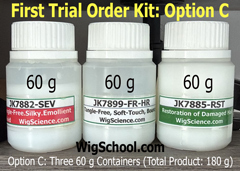
For a first trial order, we offer a special Sample Kit that allows you to test more than one formulation without purchasing a full-size package of each type.
The available combinations may include one larger sample or several smaller samples, subject to our current packaging options.
For example, you may select JK7882-SEV, JK7885-RST, and JK7889-EmC to compare their effects on your own hair products.
The total sample quantity, packaging, price, and shipping cost will be confirmed when you place your order.
Technical Note
The above information is based on JOHN KOREA CO.'s practical manufacturing experience, recommended application methods, customers' questions, and customer feedback.
Results may vary depending on the hair quality, previous chemical processing, application conditions, and drying methods.
JOHN KOREA CO. — WIG SCHOOL™
Q: If I use more than 3 mL of JK-HairCoat per liter of water, for example, 5 mL or 10 mL, will I get better results?
A: Yes and no. It depends on several factors.
Using more JK-HairCoat may produce better results in some cases, but not necessarily in others.
The appropriate mixing ratio depends mainly on:
-
Application method: Spraying generally requires a higher concentration than dipping because some of the solution is lost into the air during spraying.
-
Desired results: The appropriate concentration may vary depending on the degree of softness, smoothness, shine, and anti-tangling effect you want to achieve.
-
Hair type and condition: Human hair and synthetic fibers have different properties. Even among human hair products, the results may vary depending on the quality, previous chemical processing, and degree of damage.
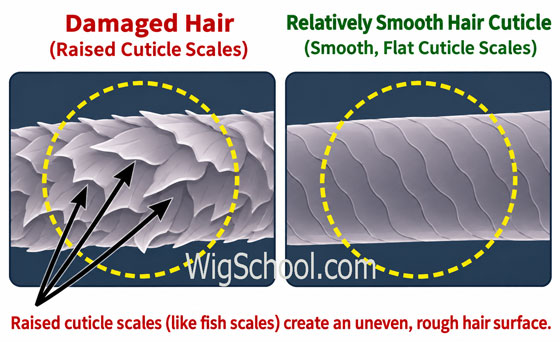
For example, a lower concentration of JK-HairCoat may work very well on relatively smooth, healthy hair (right illustration).
However, severely damaged hair with raised or protruding cuticle scales (left illustration) may require a different treatment approach.
JK-HairCoat forms an extremely thin protective layer around individual hair strands, helping smooth raised cuticle scales and uneven surfaces and reduce friction between strands.
However, it cannot completely repair severely damaged cuticles or restore the hair to its original condition.
Why does this matter?
Even relatively healthy human hair can gradually develop cuticle damage from ironing, heat drying, combing, brushing, bleaching, friction during sleep, and other mechanical or chemical processes.
As the cuticle scales become raised or damaged, the hair surface becomes rougher and more uneven, increasing friction between strands and making the hair more prone to tangling.
My recommendation:
Please conduct small-scale tests using several different mixing ratios, such as 3:1000 and 5:1000, and compare the results after the hair has been completely dried.
A mixing ratio that works well for one wig, hairpiece, or hair extension may not necessarily produce the same results on another, particularly when the products are made from human hair.
The important point is not simply to use more JK-HairCoat, but to find the most suitable concentration and application method for the particular hair you are treating.
|
|||||||||||||
|
|||||||||||||
|
 |
 |
 |
|
|||||||||
| (2)850+ |  |
 |
|||||||||||
| Copyright© JohnKorea Co® · All Rights Reserved – Seoul, Korea Cell & WhatsApp (Mr. John Yim) : +82-10-8686-1313 |
|||||||||||||



